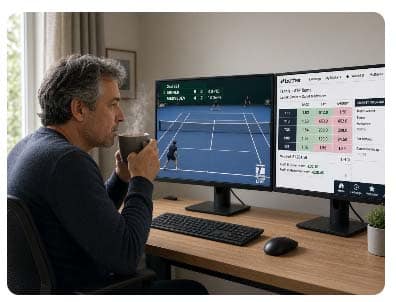
Should I Trade More Than One Tennis Match At A Time?
When there are several tennis tournaments taking place at the same time, it’s not unusual to have dozens of matches available to trade in the early part of the tournaments.
You might identify two or three matches that look promising, only to discover they’re all starting at roughly the same time.
So, should you trade more than one match at once?
You can, but that doesn’t necessarily mean you should.
And if you’re new to tennis trading, I’d suggest concentrating on one match at a time until you’ve gained some experience.
More Matches Doesn’t Automatically Mean More Profit
It’s easy to assume that trading two matches at once will give you twice as many opportunities to make money.
Unfortunately, it doesn’t work like that.
Every additional match requires some of your attention. You need to follow what’s happening, watch the prices and decide when to enter or exit your trades.
If you’re concentrating on one match, that’s relatively straightforward.
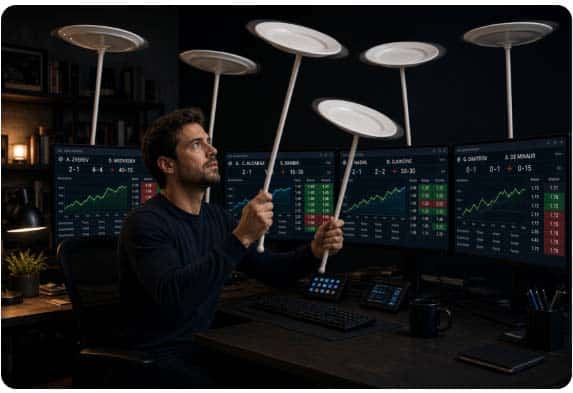
When you’re trying to follow three or four matches, things can become considerably more complicated.
You might find more opportunities, but that doesn’t necessarily mean you’ll make more profit.
In fact, spreading your attention too thinly can have the opposite effect.
Tennis Markets Can Change Very Quickly
One of the things I like about tennis trading is that you usually have multiple decent sized price movements during a match.
But those movements can also happen very quickly.
A break point, a service break or a sudden change in momentum can create an opportunity to enter or exit a trade.
If you’re watching another match when that happens, you might miss it.
Worse still, you might already have an open position that needs your attention.
Imagine you’re trading two matches.
In one match, the player you’ve backed suddenly faces break points.
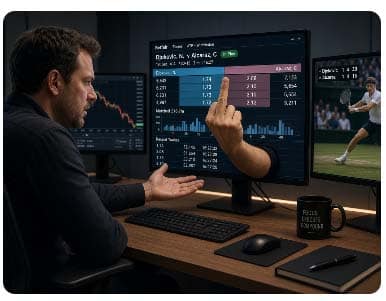
At exactly the same time, an opportunity you’ve been waiting for appears in the other match.
Which one gets your attention?
You can’t give both your full concentration simultaneously.
And sometimes a few seconds can make a considerable difference.
Two Matches Means Two Sets Of Decisions
It’s not just a question of watching two scoreboards.
Every trade requires decisions.
Is the entry price right?
Has something changed that affects the original reason for entering?
Should you close the position?
Should you wait?
When you’re following several matches, those decisions can start overlapping.
Obviously, a factor is how you’re actually trading the matches. For example, if you are simply waiting for your target entry price before backing your player and plan to exit if your player gets a break, the match doesn’t need detailed attention. However, if you’re monitoring the in-play stats as the match isn’t going quite how you expected, that match can, and should, take up most of your attention.
If you have one high attention match and one low attention match and you’re trading both at the same time, you might get away with it. Until your low attention match suddenly turns around or a player calls for the trainer. Your stress levels are about to climb.
It’s surprisingly easy to lose track of why you entered a particular trade in the first place.
And if you start making hurried decisions because something is happening in another match, you’re increasing the chances of making mistakes.

What About Experienced Traders?
There’s no reason an experienced trader can’t follow more than one match.
With experience, many of the things that initially require a lot of concentration become more familiar.
You become better at recognising situations, understanding price movements and knowing when a trade needs your attention.
You might also have one match that you’re actively trading while keeping an eye on another for a possible opportunity.
That’s very different from having several open positions that all need managing at the same time.
The important thing is recognising your own limits.
Just because you can have six markets open on your screen doesn’t mean you can manage six trades effectively.
Don’t Forget The Risk
There’s another consideration that can easily be overlooked.
If you’re trading several matches simultaneously, you may also have several positions exposed to risk.
A £20 potential loss on one match might be perfectly acceptable within your trading plan.
But if you’ve got four similar positions open, your total potential loss could be considerably higher.
A more experienced trader using £500 stakes can easily get out of their liability comfort zone if they are trading 2 or 3 matches simultaneously.
Those positions need to be considered together, not simply as separate trades.
You don’t want to discover that you’ve taken on more risk than you’re comfortable with simply because the opportunities appeared in different matches.
There’s Nothing Wrong With Missing A Match
This is probably the most important point for beginners.
You don’t have to trade every match that looks promising.
If two good opportunities appear at the same time, you can choose one.
You might even decide to leave both alone if you can’t give them the attention they deserve.
Missing a profitable opportunity isn’t the same as losing money.
There will be other matches.
One of the advantages of tennis is that there are opportunities throughout most of the year.
You don’t need to squeeze everything into one afternoon.
Start With One And Build From There
If you’re learning tennis trading, I’d concentrate on becoming comfortable managing one match before trying to follow several.
Learn to recognise your entry opportunities.
Get used to how quickly prices can change.
Become comfortable managing an open position and knowing when to exit.
Once you’re confident doing those things, you can experiment with following another match.
But don’t assume that trading more matches is a sign of progress.
Making better decisions is progress. Making more decisions isn’t necessarily.
Final Thoughts
There’s nothing inherently wrong with trading more than one tennis match at a time.
Experienced traders can do it successfully, particularly when they have a clear plan for each match.
But trading more matches doesn’t guarantee more profit.
It increases the amount of information you need to process, the number of decisions you need to make and potentially the amount of money you have at risk.
If you’re new to tennis trading, there’s absolutely nothing wrong with concentrating on one match.
You can always expand as your experience and confidence grow.
The aim isn’t to trade as many matches as possible.
It’s to trade the opportunities you can manage properly.
I’ve been trading tennis since 2008 and have traded professionally full-time since July 2010. My TradeShark Tennis Trading Course teaches the strategies and approach I’ve developed during that time, with an emphasis on selecting suitable opportunities and managing risk.
FAQ articles
Can beginners learn Tennis Trading?
Why tennis trading is lower risk than betting
Why Trading Isn’t The Same As Betting
How To Manage Risk When Trading Tennis
What Makes A Good Tennis Trading Opportunity?
How Do I Know When To Exit A Trade?
When There Are Lots Of Matches, How Do I Choose Which One To Trade?
I’m Not A Great Fan Of Tennis. Is That A Problem?
Tennis Matches Can Last For Hours. Do I Have To Sit At The PC All Day?
How Much Profit Can I Make With A £2,000 Trading Bank?
Can You Really Make Money Trading Tennis?
Why I Prefer Tennis Trading Over Football Trading
The Biggest Mistake New Tennis Traders Make
Why I Prefer Consistency Over Big Wins

Should I Trade More Than One Tennis Match At A Time? Read More »