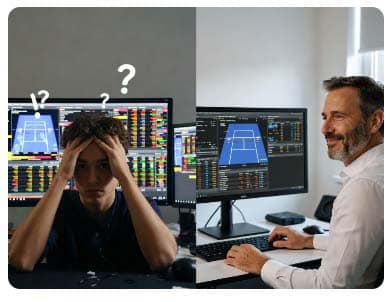
When There Are Lots Of Matches, How Do I Choose Which One To Trade?

One of the biggest challenges for new tennis traders is deciding which match to trade.

This is especially true during the first week of Grand Slam tournaments, where there can be many more matches than usual taking place at the same time.

Many beginners think they need to watch everything. They don’t want to miss an opportunity.

In reality, the opposite is true.

I understand people’s problem. In my early couple of years of tennis trading, I remember trying to monitor the scores of every live match, hoping to spot several opportunities. I didn’t want to miss out.

Successful trading is often about ignoring the majority of matches and concentrating on the few that offer the best opportunities.

More Matches Doesn’t Mean More Opportunities

It’s easy to assume that having more matches means making more money.

That isn’t necessarily the case.

A busy day can actually tempt traders into taking poor-quality trades simply because there is so much action.

I’ve always believed it’s better to trade one high-quality opportunity than several average ones.

Being selective is one of the most valuable skills you can develop.

Death by tennis ball

Start Before The Matches Begin

Good match selection starts long before the players walk onto the court.

I spend time analysing the day’s ATP and WTA schedule before the first match starts.

The aim is to identify which matches are most likely to produce the type of trading opportunities I’m looking for.

Having a shortlist means I’m prepared before the action begins, rather than making rushed decisions as matches get underway.
Also, if I am considering entering a match that is already half way through, I already have the match research to hand. I can more quickly
get up to speed with the match.

Not Every Favourite Is Worth Trading

One mistake many beginners make is assuming every favourite is a good trading opportunity.

That simply isn’t true.

What IS true is that a high percentage of market favourites do win matches.

Some favourites are priced correctly. Most are at a lower price than they should be and so they offer little value.

Others are involved in matches that don’t suit the strategies I use.

Just because a player is expected to win doesn’t automatically make the match worth trading.

Know What You’re Looking For

Before I decide to trade a match, I need to have solid reasons for the trade.

The reasons can usually vary depending on the stage of the match. It the match is just about to start or is just a few games in,
then the pre match analysis is what I would base a possible entry on.

If the match is almost over, the reason could be as simple as the fact that a player is 1 or 2 games away from winning the match but has struggled on their serve in the current set. The price will be low, so it is reasonable to assume that they won’t close out the match with no drama.
So, it is low risk with a decent chance of success.

Every trader should have clear reasons for entering the market. Imagine that you have someone sat next to you while you trade.
You have to explain to them why you are about to enter the trade. If you can’t do that without sounding like an idiot, it’s probably best
to wait for a different opportunity.

The best trades begin with a clear plan rather than a spur-of-the-moment decision.

Accept That You’ll Miss Opportunities

This is something many beginners struggle with.

No matter how experienced you become, you’ll never catch every good trade.

That’s perfectly normal. You also should not beat yourself up for not getting the very best entry price
or the best possible exit price. It’s just not realistic.

There will always be another match.

Trying to trade everything usually leads to mistakes, rushed decisions and unnecessary losses.

Missing a good opportunity is far better than forcing a bad one.

New opportunities
New opportunities

Focus On Quality, Not Quantity

When there are lots of matches, your goal shouldn’t be to have the busiest trading day possible.

Your goal should be to make good decisions.

Some days that might mean trading several matches.

On other days it might mean trading only one.

The number of trades is far less important than the quality of the opportunities you choose.

What Should I Do In the Early Rounds of Grand Slam Tournaments?

From experience, this isn’t easy to do, but pick a match and stick with it.

That doesn’t mean you should trade it from the first point to match point. Once you get a profit that you’re happy with, or once you hit your stop loss figure, move on to a different match.

Actually following this advice gets easier once you see for yourself that I does work. It is less stressful.

Use the fact that there are lots of matches to your advantage. Once you are done with your current trade, normally you might have to wait 30 minutes to a couple of hours for the next match that you want to trade. In the first few days of a huge tournament, you can find another match pretty much straight away.

That’s where the potential for bigger profits comes from.

Experience Makes Match Selection Easier

The more matches you analyse, the easier it becomes to recognise patterns.

You’ll become better at spotting situations that suit your style of trading.

You’ll also become much more comfortable rejecting matches that don’t meet your criteria.

In my experience, this confidence is one of the biggest differences between beginners and experienced traders.

Experience
Experience

Final Thoughts

Having lots of matches to choose from can feel overwhelming at first.

The secret isn’t trying to trade them all.

It’s learning how to identify the few that offer the best opportunities.

Careful preparation, patience and discipline will always produce better results than simply chasing action.

Every morning I analyse the day’s ATP and WTA matches before deciding which ones are worth trading. My daily Trading Tips service shares that analysis with members, while my TradeShark Tennis Trading Course explains the thinking behind the process and the strategies I use once a suitable opportunity has been identified.

FAQ articles

Can beginners learn Tennis Trading?

Why tennis trading is lower risk than betting

Why Trading Isn’t The Same As Betting

How To Manage Risk When Trading Tennis

What Makes A Good Tennis Trading Opportunity?

When There Are Lots Of Matches, How Do I Choose Which One To Trade? 1

When There Are Lots Of Matches, How Do I Choose Which One To Trade? Read More »

What Makes A Good Tennis Trading Opportunity?

A very common question I’m asked is:

“How do you decide which matches are worth trading?”

The simple answer is that there isn’t really a simple answer!

The first thing I would say is that you should not try to trade every match.

How you select which match to concentrate on depends on your experience.

In fact, one of the biggest improvements most new traders can make is to become more selective.

Some matches offer excellent trading opportunities.

Others are best left alone.

Learning the difference is an important part of becoming a consistent trader.

Puzzled guy
Puzzled

Not Every Match Is Worth Trading

Many beginners are desperate to be involved in the market.

This often leads to poor decisions and forced trades.

Professional traders understand that waiting for the right opportunity is part of the job.

There will always be another match.

One point that I would make here is that I discovered that I was rejecting matches based on price alone.
However, researching those matches thoroughly often highlights opportunities.

I Start With The Pre-Match Analysis

Long before the first ball is hit, I want to know as much as possible about the match.

Questions I ask include:

  • Who do I think is going to win?
  • How competitive will the other player be?
  • Is the market favourite’s price too low?
  • What is each player’s recent form?
  • Are there any injury concerns?
  • Does the surface favour one player more than the other?

The better the pre-match analysis, the easier it becomes to recognise opportunities once the match begins.

Pre match research.
Pre match research

Value Is More Important Than Picking Winners

Correctly picking the match winner can certainly make life easier for a trader. However, it isn’t essential.

Some of the best matches to trade are those where the outright winner isn’t obvious.

Instead, I’m looking for value. I am trying to take advantage of the price moves that can happen is relatively short periods of a match.

Sometimes the market overreacts to what happens during a match.

When that happens, there may be an opportunity to trade.

Finding value is much more important than simply predicting who wins.

Patience Is One Of Your Greatest Strengths

One of the hardest lessons for new traders is learning not to trade.

You don’t have to be involved in every match. Don’t rush into a trade if the value isn’t there.

Sometimes the best trade is no trade.

Patience can protect your trading bank. Sometimes a match will not give a suitable trade opportunity. Accept that fact and move on to the next one.

Pre-match analysis is important, but tennis is a dynamic sport.

Momentum can change quickly.

A player may start slowly before finding their rhythm.

An outsider may play well early on but struggle to maintain that level.

Rather than reacting emotionally, I prefer to let the match develop and see whether it creates the type of opportunity I was expecting.

I would be unusual for me to enter a trade at the start of a match unless the start price offered strong value. For example, at Wimbledon 2026, in the Quarter Final, Cobolli start at 1.45 against Fery, who I favoured to win a long match. I placed a lay on Cobolli just before the match started. Fery won in straight sets.

Have A Trading Plan

Before entering any trade, I already know:

  • Why I’m entering.
  • What I’m expecting to happen.
  • What I’ll do if the market moves against me.
  • Where I expect to take a profit.
  • When I’ll exit if the trade no longer makes sense.

Having a plan removes much of the emotion from trading.

Have a trading plan
Have a trading plan

Experience Makes Match Selection Easier

The more matches you watch and trade, the easier it becomes to recognise better quality opportunities.

You begin to notice recurring situations.

You become better at recognising when the market is overreacting.

Most importantly, you become more comfortable saying:

“This isn’t a match I want to trade.”

That confidence only comes with experience and discipline.

Before you have the experience to effectively research matches, you can use my Trading Tips service. I research every ATP and WTA match, every day.

Final Thoughts

Finding a good tennis trading opportunity isn’t about trading every match.

It’s about waiting for situations where the potential reward justifies the risk.

Good pre-match analysis, patience and discipline all play an important role.

Some of the best trading decisions you’ll ever make are the matches you choose not to trade.

If you would like to see how I analyse ATP and WTA matches before deciding whether to trade them, my daily Trading Tips service explains the reasoning behind each match. My TradeShark Tennis Trading Course also covers the methods and thought processes I use when identifying trading opportunities.

Other FAQ Articles

Can beginners learn Tennis Trading?

Why tennis trading is lower risk than betting

Why Trading Isn’t The Same As Betting

How To Manage Risk When Trading Tennis

What Makes A Good Tennis Trading Opportunity? 2

What Makes A Good Tennis Trading Opportunity? Read More »

We are using cookies on this site

Please click "Accept" if you accept our tracking cookies. You can also decline the tracking, so you can continue to visit our website without any data being sent to third party services.