When somebody starts trading tennis, there are plenty of mistakes they can make.
Using stakes that are too large. Staying in a trade too long. Entering at the wrong price. Chasing a loss. Trading matches they haven’t researched properly.
I’ve made plenty of mistakes myself over the years.
But if I had to pick one mistake that causes more problems for new traders than almost anything else, it would be this:
Feeling that you always need to be trading.
You Don’t Get Paid For The Number Of Trades You Make
When you first start trading, it’s tempting to think that being active is a good thing.
If there are ten matches available, you might feel that you should be trading several of them.
After all, you’re a tennis trader. Surely you’re supposed to trade?
Not necessarily.
You don’t make money simply because you have a position open in the market.
Every trade you enter exposes some of your bank to risk. If there isn’t a good reason for taking that risk, you’re not giving yourself the best chance of making a profit.
Sometimes the best trade of the day is the one you don’t make.
Not Every Match Is A Trading Opportunity
There can be dozens of tennis matches taking place during a busy tournament week.
That doesn’t mean there are dozens of good trading opportunities.
Some matches won’t suit your strategies.
Some won’t offer a good entry price.
Sometimes the match develops differently from the way you expected and the opportunity you were waiting for never appears.
That’s fine.
You don’t have to find another reason to enter the market.
There will always be another match.
Boredom Can Be Expensive
This is something that isn’t talked about enough.
Trading can be boring.
You might spend time researching matches and then discover that none of them gives you the opportunity you expected.
You might sit watching a match waiting for an entry point that never arrives.
The temptation is to do something anyway.
You start looking for a reason to trade rather than waiting for a reason to trade.
That’s a dangerous change in mindset.
Once you’ve decided that you want to trade, it’s surprisingly easy to convince yourself that an average opportunity is “worth a go”.
Trading Blind
I am a big believer in researching matches. Not everyone agrees with me.
When I started to research every match, I started to find opportunities in matches that I would previously have rejected. I also sometimes spot reasons to be careful while trading a match or even reasons to completely avoid a match.
I realise researching matches is seen as boring.
I talk to so many new traders who do little or no research before trading a match.
I can give you quick and easy methods of researching matches that take less than a minute.
Spending more time on the stats has significantly improved my results.
If you REALLY don’t want to do it, subscribe to my Trading Tips email service.
Don’t Turn A Plan Into A Prediction
Before a match starts, you might decide that you want to back or lay a player if a particular situation develops.
That’s a trading plan.
But what happens if the situation never develops?
A common mistake is to enter anyway because you’re convinced that you know what’s going to happen next.
Your trading plan has quietly become a prediction.
There is nothing wrong with having an opinion about how a match might develop. I do it all the time.
But the market still has to give me the right opportunity.
If it doesn’t, I don’t have to trade.

Missing A Trade Doesn’t Cost You Anything
New traders often worry about missing opportunities.
You watch a price move exactly as you expected and think:
“I knew that was going to happen.”
Perhaps you did.
But if you didn’t have the entry you wanted, you haven’t lost anything.
The dangerous part comes next.
You don’t want to miss the next move, so you enter too early or at a poor price.
That’s when a trade you should never have taken can start costing you money.
There will always be trades you miss.
I’ve missed thousands of them.
It doesn’t matter.
A quote that has always stuck in my mind is, “I would rather be out of a trade, wishing I was in, than being in a trade, wishing I was out”.
You Don’t Have To Win The Money Back Today
Forcing trades becomes even more dangerous after a loss.
You start the day with a losing trade and immediately want to get the money back.
So you look for another match.
Then another.
The quality of the opportunity becomes less important than the amount of money you’ve lost.
At that point, you’re no longer trading the match in front of you. You’re trading your previous result.
A loss doesn’t create a better opportunity in the next match.
Sometimes the right thing to do after a losing trade is absolutely nothing.
If the loss was a big one, you’re better taking a break. Take the dog out for an hour. Just get away from the PC. It’s a good way to avoid going on tilt in the next couple of hours.

A Quiet Day Can Be A Good Trading Day
One of the things you learn with experience is that you don’t need excitement.
You don’t need ten trades every day.
You don’t even need one trade every day.
If I finish a day having avoided several poor opportunities, I don’t consider that wasted time.
Protecting your trading bank is part of trading. Everyone knows that. But not everyone realises that protecting your confidence is just as important.
The aim isn’t to be constantly active.
The aim is to take good opportunities when they appear and leave the rest alone.
Patience Is Part Of The Strategy
Most people think of a trading strategy as a set of rules telling you when to enter and exit a market.
That’s only part of it.
Knowing when not to enter is just as important.
You can have the best strategy in the world, but if you use it in unsuitable matches or start bending the rules because you want some action, the strategy won’t protect you.
Patience isn’t something separate from your trading.
It’s part of the strategy.
Magic Exit Strategy
If you’re in a trade and the match and the market are moving against you, and you start to wonder what you should do, it’s probably too late.
It isn’t your exit trade that limits your loss.
It’s the entry.
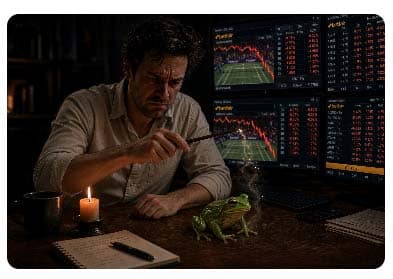
If you enter at a bad price then you have GOT to be right. If you’re wrong, deploying the Harry Potter exit move isn’t an option.
If you consistently take good value entries, it is the entry that limits your potential loss in the current set.
Final Thoughts
There are plenty of technical mistakes you can make when learning to trade tennis.
Most of them can be corrected.
The harder skill is learning that you don’t always need to be involved.
You don’t get extra points for the number of trades you make.
You don’t have to chase every price movement.
And you don’t have to make back today’s loss before the day ends.
Wait for the situations that suit the way you trade.
If they don’t appear, leave your money in your account.
It’ll still be there tomorrow.
I’ve been trading tennis since 2008 and have traded professionally full-time since July 2010. My TradeShark Tennis Trading Course teaches the strategies and approach I’ve developed during that time, with a strong emphasis on selecting the right opportunities and controlling risk.
FAQ articles
Can beginners learn Tennis Trading?
Why tennis trading is lower risk than betting
Why Trading Isn’t The Same As Betting
How To Manage Risk When Trading Tennis
What Makes A Good Tennis Trading Opportunity?
How Do I Know When To Exit A Trade?
When There Are Lots Of Matches, How Do I Choose Which One To Trade?
I’m Not A Great Fan Of Tennis. Is That A Problem?
Tennis Matches Can Last For Hours. Do I Have To Sit At The PC All Day?
How Much Profit Can I Make With A £2,000 Trading Bank?
Can You Really Make Money Trading Tennis?
Why I Prefer Tennis Trading Over Football Trading
